Low-Maintenance Garden Ideas for Adelaide Homes
5 June 2026 · 7 min read
What low-maintenance actually means in Adelaide
Low-maintenance does not mean no maintenance, and it does not mean a yard of gravel and 3 sad shrubs. It means a garden designed so the work it needs is small, predictable, and spread across the year instead of dumped on you every weekend in January.
Adelaide makes that harder than most Australian cities. We sit in a Mediterranean climate: hot, dry summers that push past 40 degrees for days at a time, and cool wet winters that do most of the year's watering for free. A garden that ignores that pattern will always be high-maintenance, because you spend the summer propping up plants that were never built for it.
Almost everything that makes an Adelaide garden hard to keep traces back to 5 decisions: the plants, the soil prep, how water gets to the roots, whether the lawn earns its place, and how cleanly the beds are contained. Get those right at the start and the upkeep drops for the life of the garden. Get them wrong and no amount of weekend effort fully fixes it. The rest of this guide works through each one.
Choose plants that want to live here, not plants you have to keep alive
The single biggest lever is plant choice, because the wrong plant is a maintenance bill that arrives every week forever. The goal is a palette that treats an Adelaide summer as normal weather, not an emergency.
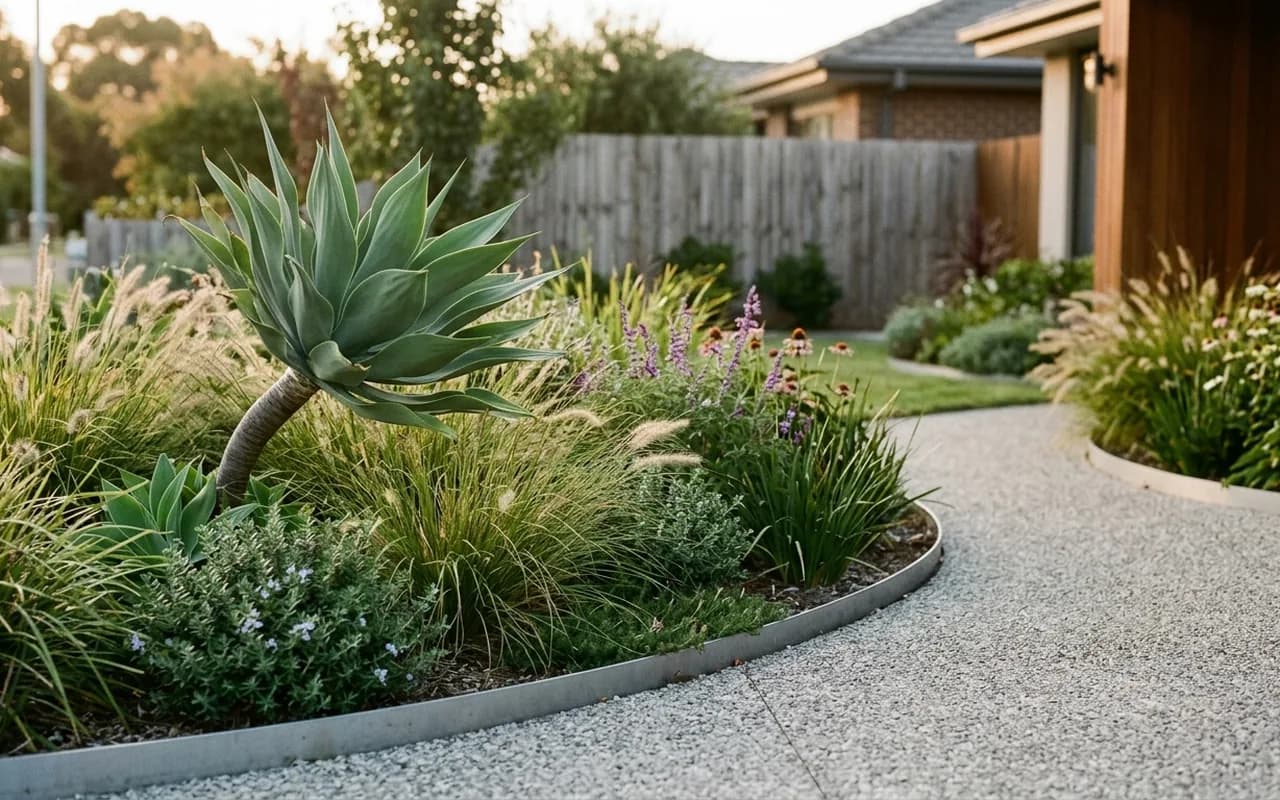
Hardy natives do a lot of the heavy lifting. Westringia (native rosemary) clips into soft structured hedges and shrugs off heat and coastal wind. Lomandra and dianella give you strappy green movement and almost never ask for anything. Correa, grevillea and callistemon bring flower and birdlife on very little water. Kangaroo paw earns its place for colour, as long as it sits somewhere with good drainage and full sun.
Mediterranean species are the other half of the answer, and they suit the climate for the same reason olives have grown in the Adelaide Hills for over a century. Olive, rosemary, lavender, westringia, salvia, teucrium and ornamental grasses like a hot dry summer and a cool wet winter, which is exactly what they get here. Many also give you grey and silver foliage, which reads as deliberate and considered rather than thirsty.
What we steer clients away from for a low-maintenance brief: thirsty exotics, soft-leafed plants that scorch by February, fast hedging like buxus in full afternoon sun, and anything that needs constant deadheading to look intentional. A beautiful plant in the wrong spot is just future work. The skill is matching the plant to your block's light, soil and exposure, which is the first thing a considered garden design settles before anything is planted.
Fix the soil before you plant, especially on Adelaide clay
Plant failure in Adelaide is very often a soil problem wearing a plant's clothes. Much of the eastern suburbs and the foothills, from Burnside through to the Hills face, sit on heavy clay that holds water in winter and sets like concrete in summer. Roots drown in July and bake in January, and the homeowner blames the plant.
The fix is done once, properly, before planting. Break up the clay, work through gypsum and quality compost to open the structure, and mound the beds 100 to 150mm so water drains away from the crown of each plant instead of pooling. Mounded, free-draining beds are why a Mediterranean palette thrives in one Adelaide garden and rots in the one next door.
On the coast, from Henley Beach down to Glenelg, the problem flips. Sandy soil drains so fast that water and nutrients run straight past the roots. There the answer is organic matter and a wetting agent to help the soil actually hold moisture, plus species that genuinely cope with sand and salt wind. Knowing which suburb sits on which soil is half the job, and it is why the same plant list does not work everywhere in Adelaide.
Mulch is the cheapest maintenance you will ever buy
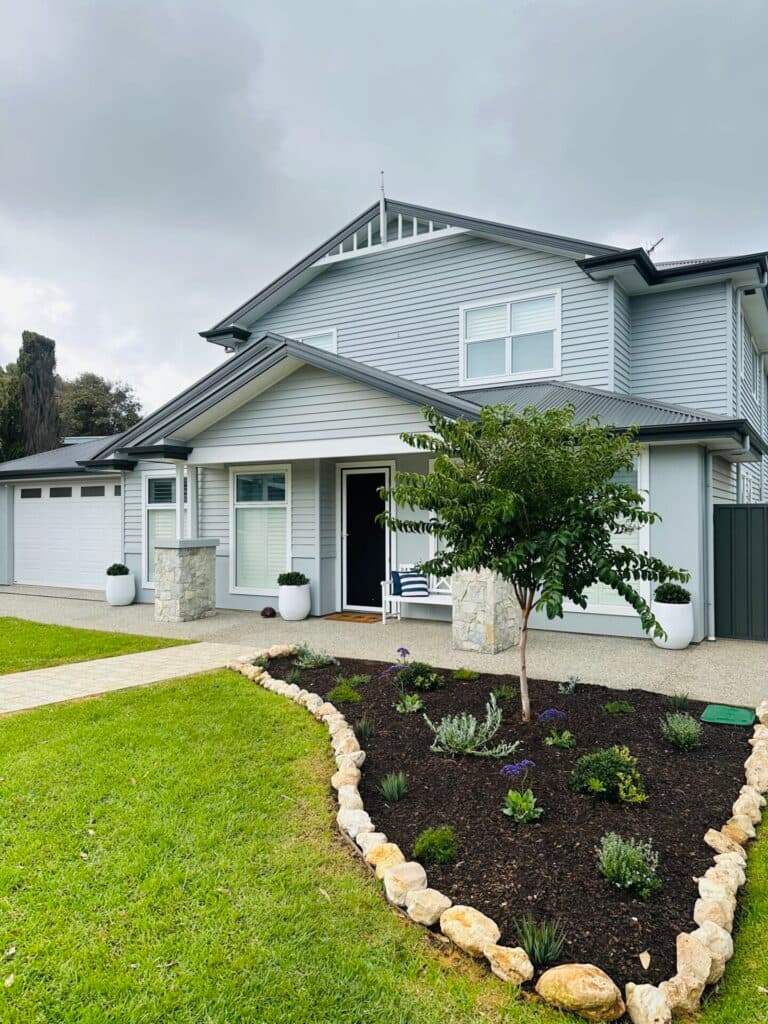
If there is one job that pays for itself faster than any other in an Adelaide garden, it is mulch. A 75 to 100mm layer of coarse organic mulch over every bed cuts evaporation hard, smothers most weeds before they start, and keeps the soil cool enough that roots are not cooking in a heatwave.
Depth and type both matter. Too thin and the weeds and the sun get through. Piled against trunks and stems it holds damp and causes rot, so it should sit back a hand's width from the base of each plant. We favour coarse, chunky mulches such as composted bark or pine bark over fine ones, because they break down slowly, stay put in a hot north wind, and only need topping up every couple of years.
The payoff is weekend hours you get back. A well-mulched bed is a bed you are not weeding fortnightly through spring, and one that holds far more of every watering. For a low-maintenance brief, getting the mulch right is non-negotiable, and it is built into how we finish every makeover.
Let irrigation do the watering, on a schedule that respects the climate
Hand-watering is the quiet reason most Adelaide gardens are higher-maintenance than they need to be. Through a 40-degree week it is a daily chore, and the moment you go away or get busy, plants slide. Proper irrigation removes the chore and waters better than a hose ever does.
Drip and inline dripper lines are the workhorses for garden beds. They deliver water slowly at the root zone where it counts, lose almost nothing to evaporation, and keep water off the foliage, which means fewer fungal problems. Paired with a tap timer or a smart controller, the garden waters itself before dawn when evaporation is lowest, and you stop thinking about it.
The climate-aware part matters in Adelaide specifically. A smart controller can taper watering right back through our wet winters, so you are not pouring water onto already-soaked clay, and step it up only across the dry months. That is kinder to the plants, kinder to the water bill, and it sits comfortably inside any water restrictions South Australia brings back in a dry year. We design irrigation as standard so the garden is genuinely hands-off, not just lower-effort.
Where artificial grass earns its place, and where real lawn still wins
Lawn is usually the thirstiest, most demanding part of an Adelaide garden: mowing, edging, feeding, and constant summer watering just to stop it going brown. For some homes the honest low-maintenance answer is artificial grass, and for others it is a smaller, smarter patch of real lawn.
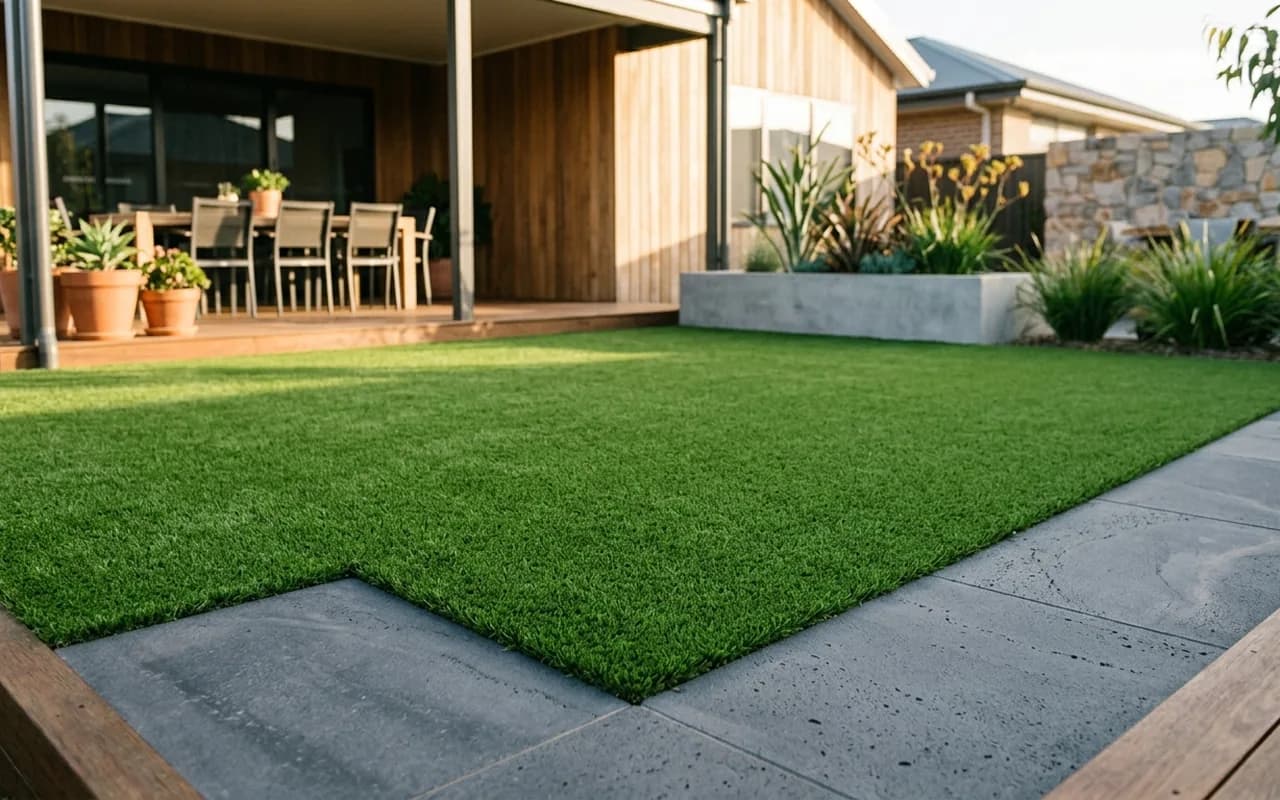
Artificial grass makes the most sense in the spots where real lawn struggles or the upkeep is not worth it: deep-shade side passages where nothing grows evenly, small courtyards in North Adelaide and the inner suburbs, pet runs, and around pools where you want clean green all year with zero mowing. Modern turf looks far better than the plastic of a decade ago, drains well, and on a properly prepared base it stays put and stays flat. The trade-off is real: it gets hot underfoot in full summer sun, and it is an upfront cost rather than an ongoing one.
Real lawn still wins where you want a soft, cool surface for kids and dogs across a bigger open area, and where there is enough sun to keep it healthy. The low-maintenance move there is not to remove it but to shrink it to the area you actually use, choose a tough warm-season turf suited to Adelaide, and put it on irrigation. A smaller, well-watered lawn beats a big patchy one for both looks and effort. We install both, and the right call depends on your block and how you use it, not on a rule.
Contain it with good edging, then let it look after itself
Edging is the detail people skip and then quietly regret. A clean, permanent edge between lawn, beds and paths stops grass creeping into the garden, keeps mulch where you put it, and holds the whole thing looking intentional rather than slowly going feral. It is also a direct maintenance saver: a defined steel or masonry edge means you are not on your knees every few weeks re-cutting a lawn line or pulling runners out of a bed. It does the containment for you, permanently, which is why we treat edging as structure, not decoration.
Our whole low-maintenance philosophy is that upkeep is designed in or out at the start, not managed afterwards. A garden that needs you every weekend was not made easier by trying harder. It was made hard by the decisions taken before the first plant went in. So we work the levers together: a climate-matched palette of hardy natives and Mediterranean species, soil prepared properly for your suburb's clay or sand, mulch and irrigation that keep water at the roots on a schedule that respects an Adelaide winter, and clean edging that keeps the whole thing contained. Done as a system, the result is a garden that holds its shape through a 40-degree summer and asks very little of you.
That is the difference between a Yardner makeover and a quick tidy-up. We start with the garden you already have, refine and restore it, and design the maintenance down so it stays good. If you want a garden that looks considered and complete without owning your weekends, request a consultation through the site or call us on 0405 306 789, and we will walk the space with you and map out exactly what yours needs.